
ListView
A ListView is like a ScrollView but it should have a for element, and the contents are
automatically laid out in a list.
In a ListView, elements are only instantiated if they are visible, which guarantees stable performance with a practically unlimited number of items. ScrollView is more suitable for free-form content.
import { ListView, VerticalBox } from "std-widgets.slint";export component Example inherits Window {    width: 150px;    height: 150px;
    VerticalBox {        ListView {            for data in [                { text: "Blue", color: #0000ff, bg: #eeeeee},                { text: "Red", color: #ff0000, bg: #eeeeee},                { text: "Green", color: #00ff00, bg: #eeeeee},                { text: "Yellow", color: #ffff00, bg: #222222 },                { text: "Black", color: #000000, bg: #eeeeee },                { text: "White", color: #ffffff, bg: #222222 },                { text: "Magenta", color: #ff00ff, bg: #eeeeee },                { text: "Cyan", color: #00ffff, bg: #222222 },            ] : Rectangle {                height: 30px;                background: data.bg;                width: parent.width;                Text {                    x: 0;                    text: data.text;                    color: data.color;                }            }        }    }}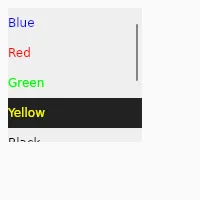
Properties
Section titled “Properties”Same as ScrollView.
Callbacks
Section titled “Callbacks”Same as ScrollView.
Functions
Section titled “Functions”ensure-row-visible(row: int, behavior: ScrollBehavior)
Section titled “ensure-row-visible(row: int, behavior: ScrollBehavior)”Call this function to scroll the list so that the row at index row is fully visible.
A row above the viewport, or a row taller than the viewport, ends up at the top edge.
Any other row ends up at the bottom edge.
A row that’s already fully visible doesn’t move, but a running scroll animation stops.
If row is out of range, the call does nothing.
Pass ScrollBehavior.instant to jump or ScrollBehavior.smooth to animate, see ScrollBehavior.
import { Button, ListView, VerticalBox } from "std-widgets.slint";export component Example inherits Window {    width: 150px;    height: 150px;
VerticalBox { Button { text: "Show row 42"; clicked => { list.ensure-row-visible(42, ScrollBehavior.instant); } } list := ListView { for i in 100 : Text { text: "Row \{i}"; } } }}© 2026 SixtyFPS GmbH